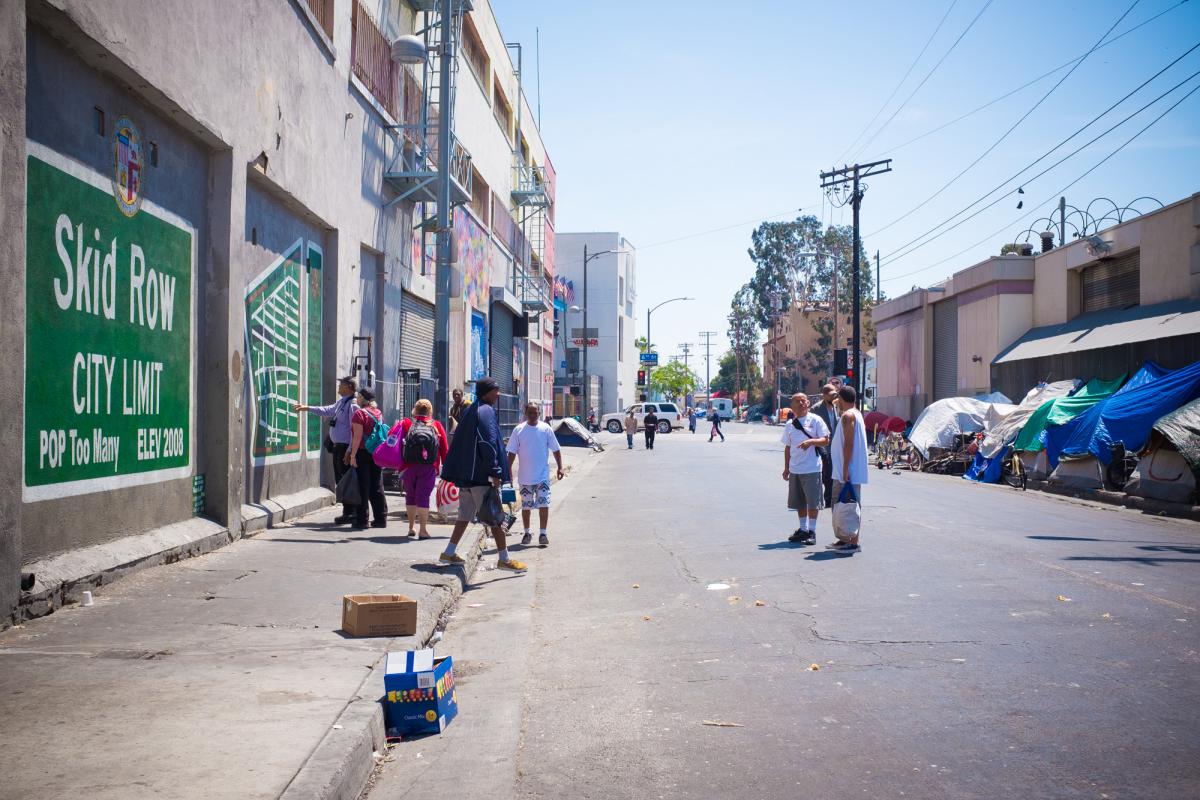
Tonight I head to Los Angeles!

Disneyland? No. Santa Monica? Ah…no.

Skid Row? Yip.

Over the next twelve days, Professor Peter O’Connor from The Creative Thinking Project will work closely with downtown LA organisations working to aid and abet homelessness—among them Urban Voices, My Friend’s Place, and Skid Row Housing Trust. Our workshop will pose questions about the visible and invisible strands of those who live on the streets of Los Angeles. Feel free to read more below, the words of which are taken from the original Newsroom article.

How do you measure misery? Justin Brown travels to ‘the worst man-made disaster in the US’ where he finds hope in theatre.

It’s one in the afternoon and I’m sitting on a park bench outside Verona Cafe on K Road, Auckland. Two men sit beside me. One is drinking warm beer from a 750ml bottle as he chats to a man in a wheelchair with a cigarette butt hanging from his mouth. The men pass the butt to each other, inhaling what is left of it. The man in the wheelchair has an issue with his right leg, it is bloated and twice the size of his left. His mate unscrews the cap of his pawpaw cream tube and rubs some on his friend’s leg, laughing. ‘Now don’t go getting any ideas!’

I soon learn that one of these men has been homeless for 26 years. I feel ridiculous and ashamed about the MacBook in my backpack, the iPhone in my pocket, and the cash in my wallet. The men pass around 50c coins as if they are gold. I give them $20 to buy a burger, knowing where the money will go. Even so.

As I walk to my car I half expect to catch Six, the editor of the K Rd Chronicles who recently hosted a web series of the same name. I loved that series. It gave me an appreciation of what happens on a road where both awful and beautiful things happen, a road which few of us want to think about, mostly because the topic of homelessness involves sticky, murky, uncomfortable questions. Why is it one of our country’s most pressing problems? How did we allow this to happen? Why don’t we care?

A few months later I meet the star of the show herself. Six, whose blurb on K Rd Chronicles describes her as an ‘overqualified, underemployed, transgender journalist’. Six sits cross-legged outside St Kevin’s Arcade, she is selling her community newspaper. I stop. Should I approach her, tell her how much I enjoyed the series? But what will I say? Don’t be such a wimp. As I should have expected, Six is engaging, smart and polite. I take a copy of the paper and go for coffee, unaware just how important her series will be to me.

====

A few kilometres from K Rd lies the Hobson Street Theatre Company, a place Professor Peter O’Connor (The University of Auckland and The Creative Thinking Project) knows well.

HSTC is New Zealand’s only theatre company made up of people who are, or have been, homeless. It’s also where Peter created That’s What Friends Are For, a play that ran for five nights at Auckland’s Basement Theatre. The show was advertised as an experiment to discover whether the cast could make friends with the audience in just one hour. In September 2019, the show would be presented with the supreme Creative New Zealand Community Arts Award and the homeless cast were flown to Parliament to receive their award.

Six months later and Peter receives an invitation to Los Angeles to create a performance with arts organisations working with the city’s homeless. Skid Row, in particular. He is asked to collaborate with LAPD (Los Angeles Poverty Department), The Skid Row Housing Trust, Urban Voices, Piece by Piece Mosaic arts and My Friends Place in a bid to create a performance in one week at the Museum of Contemporary Art.

====

‘Justin, wanna go to LA?’

It’s Peter.

‘Sure,’ I reply. ‘What for?’

‘Surfing.’

Silence.

‘Just kidding. I want to make a show about the possibilities inherent in hope. To create a play about seeing Skid Row not as a problem but rather about seeing the possibilities of the homeless of LA. To witness strength, purpose, and beauty amidst the ugliness. Let’s celebrate the beauty of survival against all odds and mourn those who have succumbed.’

‘Um, sure, yes, of course! But … what’s the show about?’

‘Dunno?’

‘Who are the actors?’

‘We have been allocated a cast of 25 .’

‘Wait, are you nervous?’

‘Shitting myself.’

All of this despite Peter having created and researched theatre in earthquake zones, prisons, schools, psychiatric hospitals, after terror attacks and with the homeless for nearly 40 years.

====

Andy Bales, CEO of the Los Angeles Union Rescue Mission has called Skid Row ‘the worst man-made disaster in the US, a place where 53 blocks of abandoned people have been left to die.’ Those 53 blocks account for approximately 13 percent of the 36,135 homeless individuals in Los Angeles. Since 2012, the number of homeless in Los Angeles has increased by 50 percent. Skid Row itself is home to approximately 5000 people. Imagine the entire population of Warkworth or Cromwell each living in little more than a one-man tent.

After a recent visit to the area, Peter warns me I’ll be in for a shock. ‘The level of human misery on the streets is like visiting a war zone,’ he says. ‘The overwhelming smell of urine and human waste, abject poverty, and loss of hope in the faces of so many is deeply impacting.’

Why such a toilet shortage? Corruption. A decade ago 27 Porta-Potties were placed on Skid Row and from day one gangsters charged the homeless anything from one to five dollars to use them. These days there are fewer than a dozen toilets, forcing many dwellers to use buckets, which are emptied into the street or trash cans. Once a day, the streets are power-washed by authorities to stop disease.

Peter: ‘Yet in the midst of such despair, I found arts organisations doing extraordinary work, rebuilding community and creating moments of beauty that act as an antidote to the ugliness of people’s lives. These social service agencies are committed to reminding the city that Skid Row isn’t the problem, it’s a symptom of a wider problem of human greed that also impacts us in New Zealand. Our show is about the possibilities of Skid Row, of asking people to look with fresh eyes at the beauty and capacity and glory of those who live on these streets.’

====

In the past, my travel books have been light and fun, though they’ve always been about people. In UK on a G-String, I door-to-door busked my way around the Motherland. In Teed Off in the USA, I attempted to play golf with whoever featured on the front page of the newspaper in whatever town I was visiting, and in Bowling Through India the Black Craps and I challenged street kids to games of cricket. LA is very different. Peter isn’t the only one kakking himself.

As an ambassador for The Creative Thinking Project, I’ll be leading the documentary team. I’ll try to capture the moment, to find the story. I’ve met the Los Angeles crew on a conference call only, though as soon as I hung up I realised what a scarily brilliant beautiful honour it was to be invited to help curate a performance at one of the city’s major cultural institutions.

Ah, Doubt, I didn’t see you there! What if the whole project tanks? Is it possible to create a performance in one week that highlights the enduring spirit of hope and resilience in the depths of extreme poverty and despair in one of the richest cities on the planet?

What about our American mates? What do they want to achieve? Amanda Hunt, Director of Education and Senior Curator of Programs at MOCA is interested in revealing the artistic and creative potential of the city’s homeless. ‘In doing so,’ she says, ‘we believe it unveils and reminds the city of the humanity of those who live on our streets.’

How do you measure misery? More to the point, how do you fix it? An actor named Richard took part in That’s What Friends Are For at The Basement Theatre. When he was asked what he enjoyed most about the experience he replied, ‘You want to turn your negatives into a positive, and theatre is a great way to do it. Hopefully, I’ll keep doing it for the rest of my life and I know a lot of the cast feel the same. We shine when we’re on stage.’
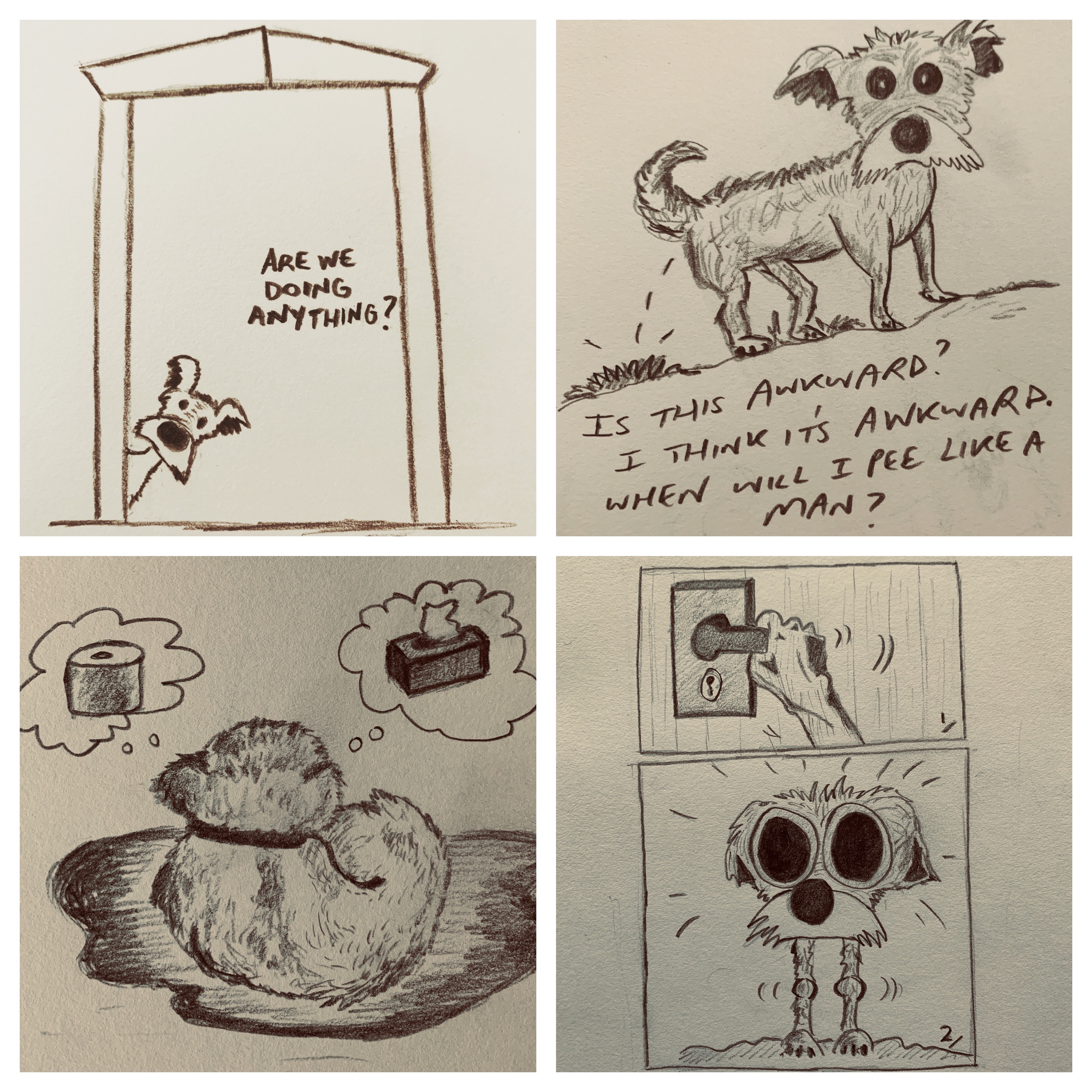
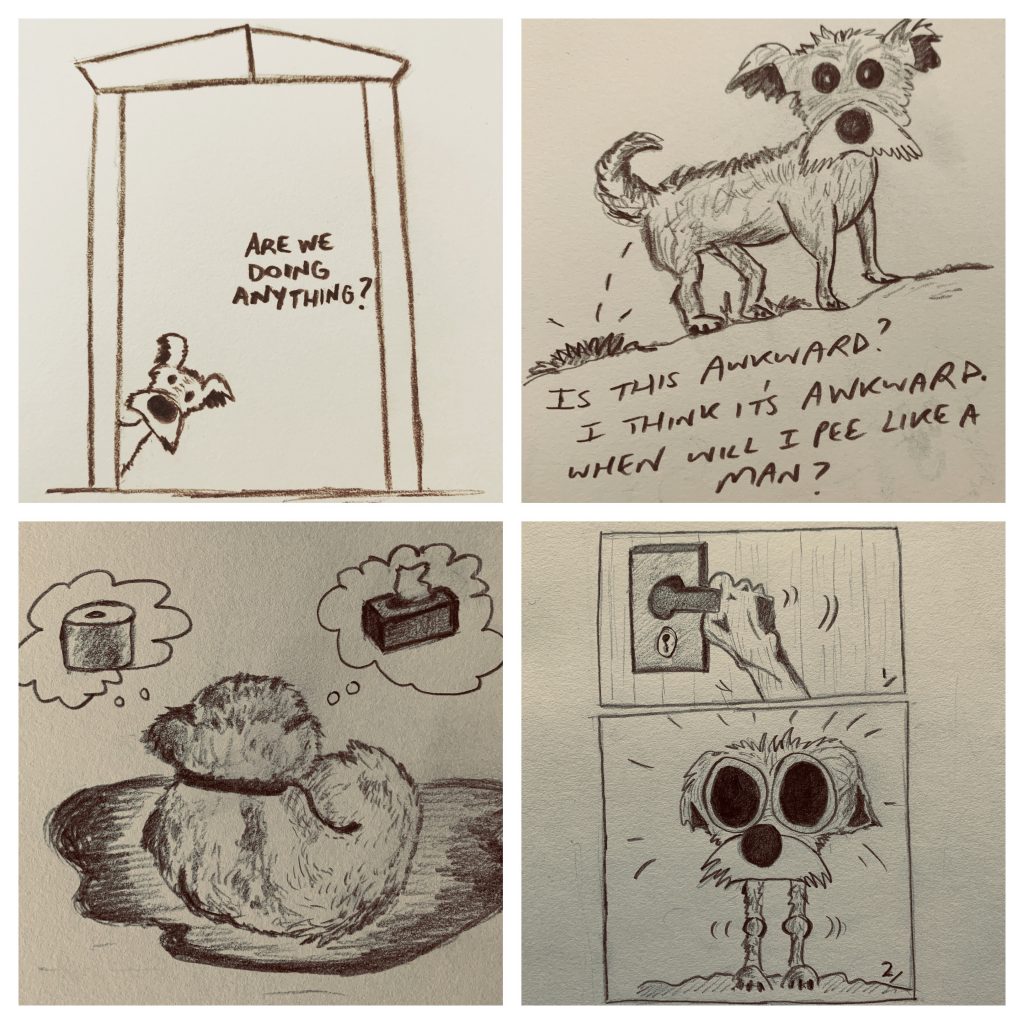
My dog is a pain in the arse, but I love him.

I love him because he’s instantly become a part of our family. Growing up, we always had a dog in our house, (RIP Holly, Amber and Charlie), but I’ve never owned one myself.

Another thing that occupied my time growing up was cartooning. My sister and I never stopped, all mum had to do when she wanted a cask of wine at the neighbours was to supply us with a pen and paper. We’d lie on our stomachs on the carpet and create. We never stopped. Only, over time, I did.

Something else has been on my mind lately. Lifelong learning. We all dream of it, but what if we get to a point in life where we sit comfortably in our comfort zone and quit? Why the hell would you go to university aged 67? What’s the point of learning Spanish if you’re never going to visit? Personally, one day I want to make guitars? Will I?

It’s often said that we revert to doing what we did as kids. For me, that was cartoons. My dog Cooper is teaching me how to do it properly. You’ll get to meet him on my new Insta page. Woof.

Friday life lesson – START THAT THING TODAY.

It’s an overcast winter’s day at Hu’s Farm in Riverhead, Auckland. I’m here to hang with three other artists as they each create a work, to be showcased at an upcoming exhibition called AMUSE BOUCHE.

Yuan Keru, Shen Piji & David Ye have just arrived from Shanghai and are a part of the ‘2019 Chinese Young Artist Residence Programme.’ Their brief? To create a piece which revolves around ‘luscious intoxications of introductory experiences.’ But first, we need to find our rooms.

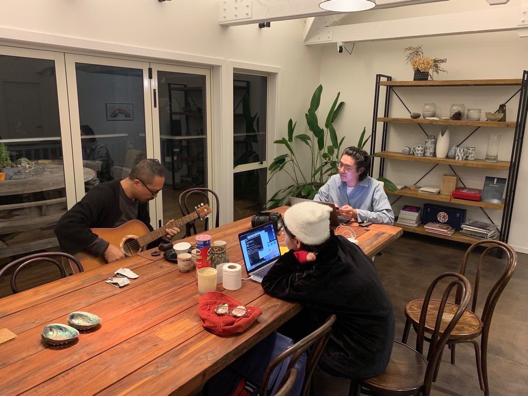
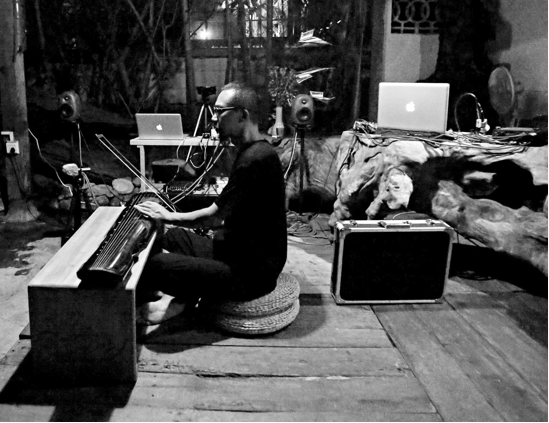
Clockwise – Piji plays guitar while David and Rubeta dream up ideas.  

Day One

As I’m introduced to the three artists the feeling I have is one of embarrassment. Why do so many Chinese feel they have to change their names so that Westerners can pronounce them? Are we really that useless? Yuan Keru is a wonderful young filmmaker from Shanghai.

Yuan, lovely name. She introduces herself as Rubeta.

I also meet David Ye, a smartly dressed fashion photographer from Shanghai whose works have featured in ‘Vogue Italy’ and the Asian edition of ‘Forbes’ magazine. He is joyous and cheeky.

Shen Piji is an ex-punk and mixed-media contemporary artist who I met the previous night at an informal launch for the project. Piji is dressed like a monk, all in black, and is dying for a cigarette. A friend of his translates. ‘Piji really misses those punk days. Did you know he locked himself in the forest for 10 years to learn the guqin, a plucked seven-string Chinese instrument of the zither family and the most revered of all Chinese musical instruments. It has a history of about 5,000 years.’

‘Oh, wow.’

‘He looks old, but he’s not.’

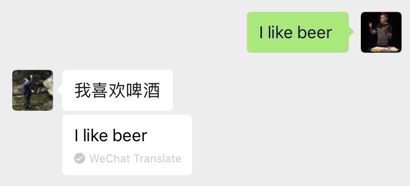
Hu’s Farm is scattered with laptops, power plugs, leads, camera equipment and tripods. For the next week we will live in each other’s pockets. Rubeta, Piji and David will each make something. I’m here to follow their creative journey and write about it. Who are these artists? What makes them tick? What are their creative processes? To make some sort of sense of this I download Google Translate and open the ’Hello Chinese’ app on my phone. Then I remember, much to the surprise of my new friends, I have a WeChat account, the most popular social media platform in China.

Technology, the wonderful enabler.

While Rubeta and David head to Auckland city to shop for props, I talk to Piji and soon discover his English is as bad as my Mandarin.

But we find common ground.

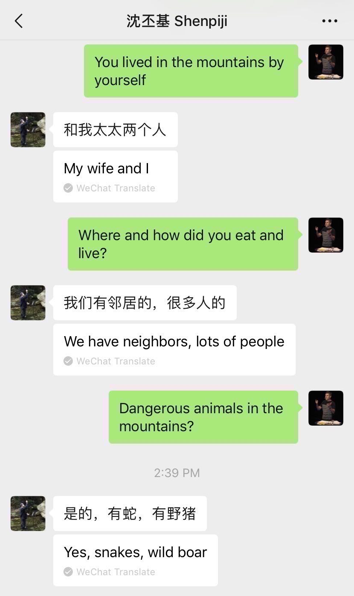
As we drink Lion Red, I punch in a few more words. I want to know about the decade he spent in the forest.

Piji has worked and lived in Shenzhen, China since 1993. Back then he was heavily involved in contemporary art and avant-garde music. He left his punk band ‘Sunflower’ when he fell in love with the guqin and 16 years later would conduct a ‘Ted Talk’ on how he used the instrument to talk to frogs.

In 2015 Piji placed five pottery jars into a shallow pool in his studio which soon attracted a group of frogs named Hylarana Daunchina. He used the difference sizes of the jars to change the volume and frogs’ tone, mixing those sounds with the sound of the Guqin playing. Piji did this every day and recorded numerous songs with his new friends.

‘So you played music to frogs and they talked back?’ I ask. Piji nods. ‘Did you pay them?’

‘I fed them,’ Piji replies.

‘Wow, that’s amazing. Ever thought of doing the same thing with sheep?’

(Shen Piji the frog whisperer at his home in Shenzhen.)

David’s wife Lulu and I concoct a meal made from leftover lamb, ginger, onions, rice and pumpkin. Piji has a controversial addition, chopped up cheerios from the fridge. While we cook dinner I learn the word for pumpkin, plate, and rice, and forget them immediately. I make instant friends by telling everyone I have a car should anyone need a ride anywhere. Piji is equally excited when he spies my guitar, which he plays in an instant and confirms I should never attempt a tune in this man’s company.

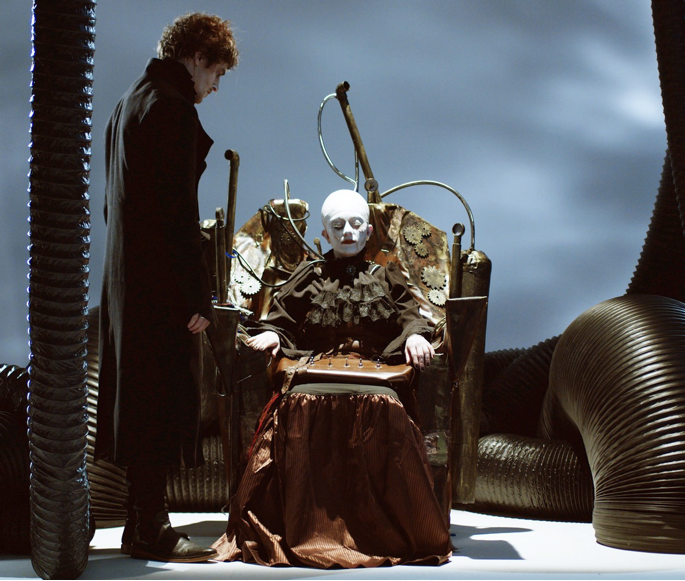
I want to know more about Rubeta’s and David’s works. Rubeta was born in Hangzhou, China, and currently lives in Shanghai. She graduated with a Masters in fine art from the School of Inter-Media Art at the China Academy of Art, Hangzhou. Her artistic practice focuses on exploring the act of painting, spatial rhythm and narratives in video, combining the emotive experience with history, mythology and dreams. Her works are melancholic and violent and are often immersed with warmth and poetry. Her film Fleeting Strangers was selected for the Los Angeles Chinese Film Festival in 2017.

’I use friends, but I can’t pay them a lot.’

‘But how do you make such elaborate films on such a small budget?’

Res, a character from Rubeta’s film ‘Fleeting Strangers.’

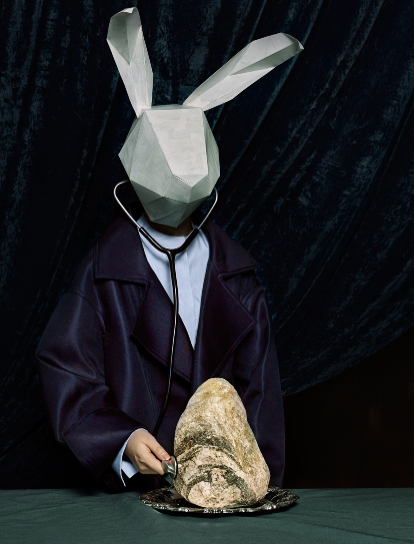
Fashion photographer David thinks of ideas by watching the news and talking to friends. ‘Coming to New Zealand,’ he says, ‘is going to make my heart strong. Shanghai is so fast everyone is trying to make money.’ He says that back home in the commercial sector he struggles with not being allowed to use his own ideas, yet his works, I think anyway, are racy and unique.

(David’s Levraimoi brand shoot, 2017)

Day 5

Fried prawns for breakfast, again. David loves his prawns! Afterwards, he and Rubeta return to the city to shop for clothes, shoes and earrings for their shoot later in the week. When they return and unload their haul I ask Rubeta if she has a story in mind. She shakes her head. ‘But you’ve bought the clothes?’

‘This is how I work,’ she replies. ‘I buy the clothes and create a character and a story around that.’

I sense it’s been a frustrating day. Working away from home is tough. It looks like everyone is just sitting around yakking, drinking tea, but I have no doubt there are ideas aplenty beneath the bonnet.

Shoot Day

Someone poked the bear. Everyone is up before 8am. The energy in the lounge is manic. Rubeta’s fashion model broke her finger last night. I make some calls to try to find a replacement when the injured girl calls to say she’ll make the shoot after all. I feel for these guys. If they were at home in Shanghai they could make a quick call and fix the problem.

It’s a race against the clock. We wait for the weather to clear. I watch David work. He smiles a lot and has the rare ability to make his talent feel relaxed and ready. Rubeta dresses her models for her film, one of whom is Piji. Ha! Glad that’s not me!

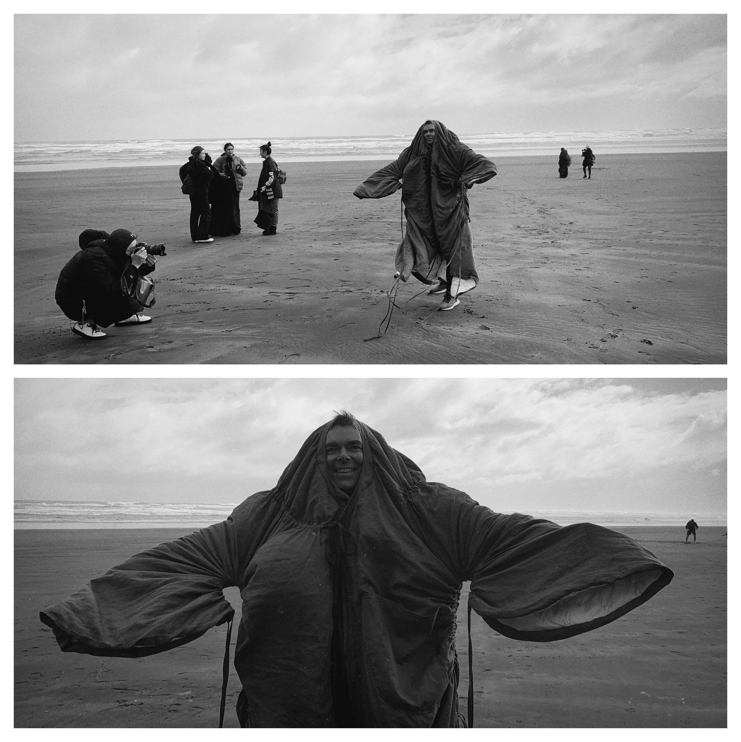
‘Justin, please wear this,’ David says, handing me a garment which looks like a cross between a ridiculously huge sleeping bag and something a giant Jawa from ‘Star Wars’ might wear.

‘Um, okay?’ I reply. ‘But what do I do?’

‘We go to beach. Murawai!’

‘David, mate, it’s raining. It’s pouring and windy, you’ll get black sand all through your equipment.’

‘We try!’ he says, smiling.

Above – The author, thankful his mates are nowhere near.

10 days later

It’s the night of AMUSE BOUCHE, the exhibition at Hu’s Farm in Riverhead. A crowd gathers. There is beautiful wine and food. Piji plays an original piece on the guqin, along with supremo Kiwi musicians Richard Adams and Nigel Gavin, and presents his artwork. A bleary-eyed Rubeta, up half the night editing, walks us through her short video pieces ‘Before the Storm,’ ‘Clone and Mirror,’ and ‘Reality Park.’ Shot in Murawai, K Road in Auckland, and Taupo, these stories both challenge and charm the viewer.

As for David, his genius behind the lens confirms that you really can put lipstick on a pig.

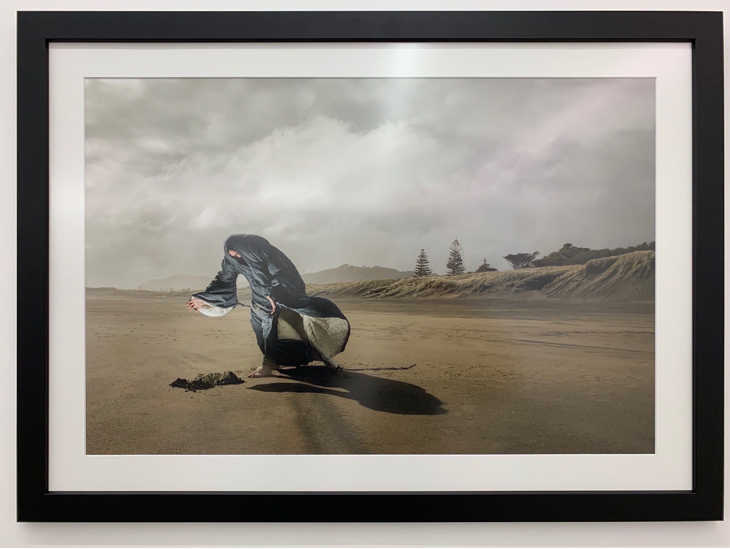
Above – ‘Strangers’ by David Ye.