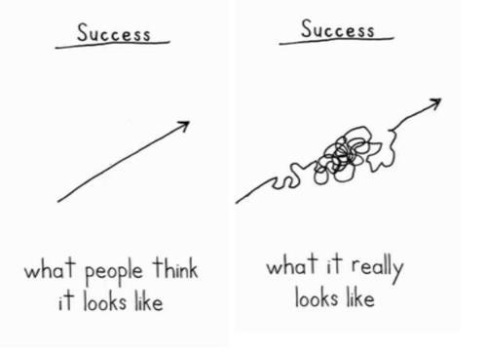
Writing is something I have to do. It is not a chore and it sure beats watching TV or scrolling. And it’s fun. What a cool thing to be able to create your own story, to make your characters do things you would never do.

But what if your story sucks? Who cares, no one but you will see that shitty first draft. My advice is hardly original: just start. Just start? Yes. Make. A. Mess. Dive in, have fun, tell your truth.

50 words becomes 500 becomes 50,000.

What the hell just happened? Did I just write a book? Yip.

For what its’ worth, here are some thoughts from a recent interview.

Justin, how do you come up with new characters?

Think about the characters in Roald Dahl’s books – they are hilarious, gross, or really super lovely. Readers won’t care about characters unless they are believable. Think about if you were your character, how would you feel? What you like in them is a part of you; you’ve got to recognise it before you can use it.

Where do you get your ideas?

Relax, play sports, see your friends, live. Go with those ideas most alive in you.

Which ones evoke the most energy and passion? Do that.

How do you start a story?

Write when you’re tired and when you don’t want to write. Try to write for an hour a night instead of watching TV. This can become two hours. 100 words become 1000, which becomes a book.

My daughter once wrote a wonderful story called ‘Cinderella’s Bad Day,’ whereby the poor woman dies every day in a myriad of ways. Shot by a creepy hobo. Killed in a rabbit invasion, picked up by an Enderman and dropped into hot lava and eaten by robotic crocodiles. Every time I thought a particular death might be too graphic for the school kids I was reading the story to – they squealed with delight.

Do you have your characters fully planned out in your head before you start, or do you let them develop as you write the story?

My book Stowaway Daze arrived fully formed, including names, setting, and title! Some writers like to see what happens, while others plan meticulously. I’m a bit of both. The most important thing is that you know how your main characters will react in any given situation. It’s creepy when they start doing things by themselves!

Should I write the ending first?

Endings are hard, get yours working up front. Finish your story, and let go even if it’s not perfect. In an ideal world, you have both but move on. Do better next time.

When you’re stuck, make a list of what wouldn’t happen next. Lots of times the material to get you unstuck will show up.  A very famous novelist named Ernest Hemingway suggested stopping writing when a scene is going well. That way you can come back to it and begin with ease.

How do you know when your story is finished?

Make it as perfect as you can and as easy to read as possible. Endings can change, and so can character, but a lot of these issues and challenges might arise once you rewrite the story with an editor. That’s the best part.

Above all, make it sparkly, and be proud of it!

IMPORTANT: When you have completed your story, don’t read it for two weeks. Come back to it with fresh eyes!

What about if the story is no good? Have I wasted my time?

Not at all. No work is ever wasted. If it’s not working, let go and move on – it’ll come back around to be useful later.

What’s the secret to writing a GREAT story?

1. Think of a weird or unusual idea that the reader can’t resist

2. Use short sentences to hook the reader in and to make the story sound tense and exciting.

3. Short paragraphs are easier for the reader,

4. Introduce dialogue to involve the characters, help reveal their personalities and add new information to the plot.

A lovely quote from American author Ray Bradbury

‘If you stuff yourself full of poems, essays, plays, stories, novels, films, comic strips, magazines, and music, you automatically explode every morning like old faithful. I have never had a dry spell in my life, mainly because I feed myself well, to the point of bursting. I wake early and hear my morning voices leaping around in my head like jumping beans. I get out of bed to trap them before they escape.’
Q – I’m rewriting my first novel and would like to know how to grab an agent’s attention when submitting.

Justin – There is no right or wrong way, just make sure you’ve done the obvious things right – spelling, grammar, etc. You know the drill. Just be polite. Be aware they read thousands of submissions and seem to enjoy the process about as much as filling in a tax form. Therefore make it easy for them. Good tone to the letter, sizzling teasers, and then be patient.

And start writing something new right away.

I currently have the beginning and end of my book and am having trouble stringing events and character motivations together to make the entire thing complete. Of course, this still means I’m in my outline phase. Do you think I should scrap my idea because I can’t put the beginning and end together, or any other advice?

All I can offer is my experience. I have one unpublished book for 8-12-year-olds. I’m on draft number 10. It has taken me that long to discover what the actual story is. There are two options – you can either struggle away or (gasp) put the book aside. That way you can start on something else, and often when you start on something else, ideas arrive for your first story. Re outlines, some people use them, some don’t. It’s whatever works for you. Joanna Rowling did alright by using one.

How do you get started, especially when it’s a passion and you have a career-oriented day job that pays the bills.

You write. Write when you’re tired, when you’re hungover, when you don’t want to write. If you love the craft enough you’d do it at 2 in the morning if someone asked you. I write when I cook, no jokes, I have the laptop open and add any lines that come to me. Which can be damn annoying. And dangerous.

Working and writing at the same time can be tough. Maybe try to write for an hour a night instead of watching TV. This can become two hours. Soon enough you’ll be more into your own story than any lame show on telly. 100 words becomes 1000, becomes a manuscript. The first draft will be shit, it always is, but keep going.

Do you have your characters fully planned out in your head before you start, or do you let them develop as you write the story?

This is rare – my latest manuscript arrived fully formed, names, setting, title. It was bizarre. Again, some writers like to see what happens, others plan meticulously. You’ve got to know how your main characters will react in any given situation. Once they start doing things by themselves, now that’s creepy.

How do you know a manuscript is ready and it’s time to stop editing/revising?

Make it as perfect as you can and as easy to read (and follow) as possible. Endings can change, so can character, but a lot of these issues and challenges might arise once you’ve actually scored a contract when you’ll have time to rewrite with an editor. That’s the best part. Make it sparkly, be proud of it before you hit send.

How do you introduce things like currency when there’s no direct way to correlate it to our universe. I’m writing a fantasy book in a different universe that while some things are the same, things like the currency are entirely different and I have no idea how to incorporate the value of this currency without stating it outright.

Make it up! It’s your story. 3 spigglets = 1 grosnipod. As long as you’re consistent, and more importantly that the reader understands, you’ll be okay. Please don’t complicate the reader. It’s a right ol turn off.

Does every idea, even the good ones, feel hopeless or not-worth-it at some point? I’ve never finished a single first draft. I wrote for years, recently switched over to comic scripts and screenplays and stuff because I was having ideas that fit that format and they’re so much easier to finish. Is every idea going to try to beat me up at some point?

Finish the damn book. Australian guitarist Tommy Emmanuel talks about The Shitty Committee who jump into your head and tell you how bad your piece of work is. Finish the damn book. Because if you do, you have a completed work, and if it’s not perfect, something similarly amazing could come out of the process: a character, a title, an idea. Go for it.

Having seen some scary stuff about fake publishers and stealing people’s writing, how do you find a real (and good) publisher and/or agent?

You gotta kiss a lot of frogs. Re fake publishers, ask around or google, you’ll know if it sounds too good to be true. ‘PAY US TO READ YOUR MANUSCRIPT!’ Really, now come on. This is, however, a long game so take your time finding the right team. It’s not easy, but what is? It’s the 10,000 hours thing. It’s no different. Good luck!

How many of your 31 published books do you hate?

Good question. No writer is ever 100% happy with their work, there’s always something that niggles years later. I don’t hate any of them, it’s a cliche but the whole thing has been a journey, so there are some works I like less than others.

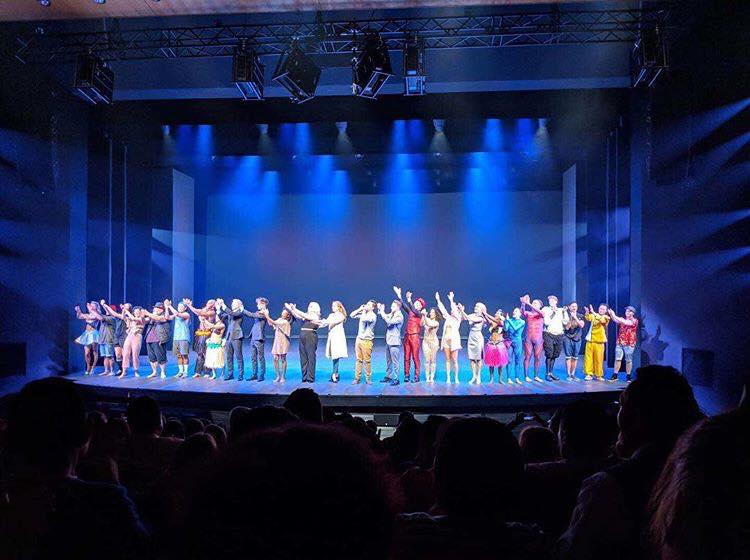
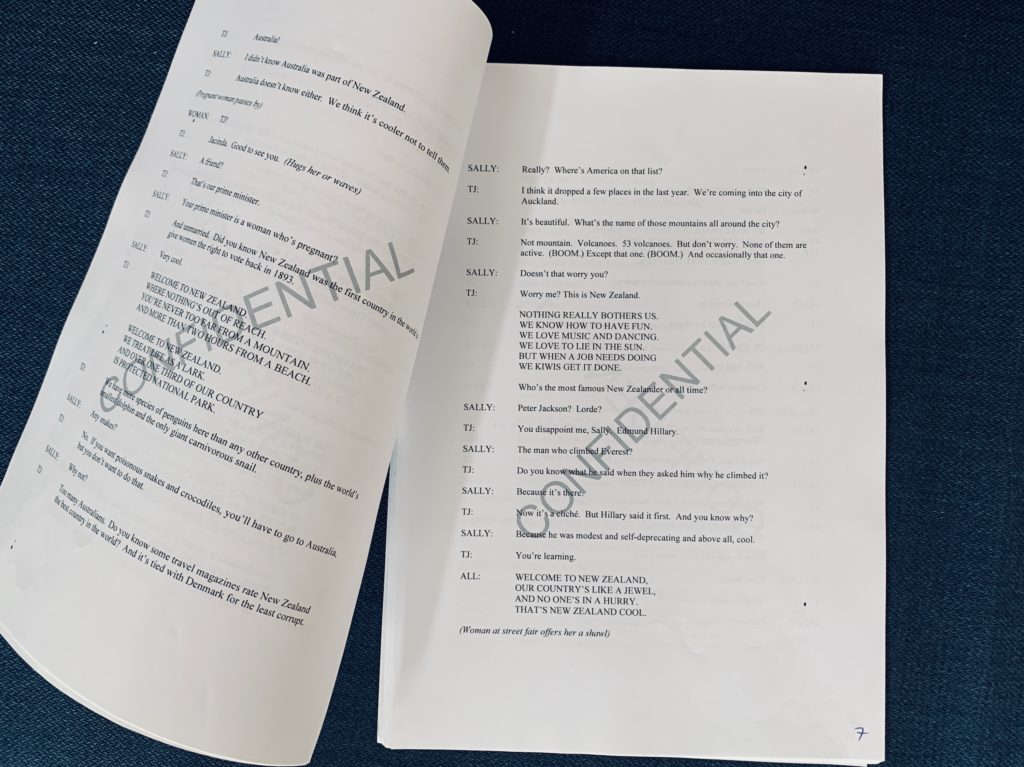
I was invited to write a story concept for what was to become a live musical comedy about Auckland. The story would encompass love, travel, Auckland city itself, and most importantly, showcase New Zealand to the rest of the world. The City of 100 Lovers was born, an 80-minute show, with more than 150 costumes, 16 musical numbers, including 11 original songs.

I’ll admit I may have been rocking on the back of my heels pre-show but there was no need. City of 100 Lovers kicked off with a thunderous bang. Brilliant and funny with a tuneful crew, this is a show for Kiwis from all backgrounds, with a few un-pc and inappropriate moments biffed in for good measure. I may have had a tear in my eye during the final song.

Creative Crew: Justin Brown, Vincent Ward, Tony Stimac, Tom McLeod, Taiaroa Royal, Ian Aitken. 

Above: An early draft of City of 100 Lovers.